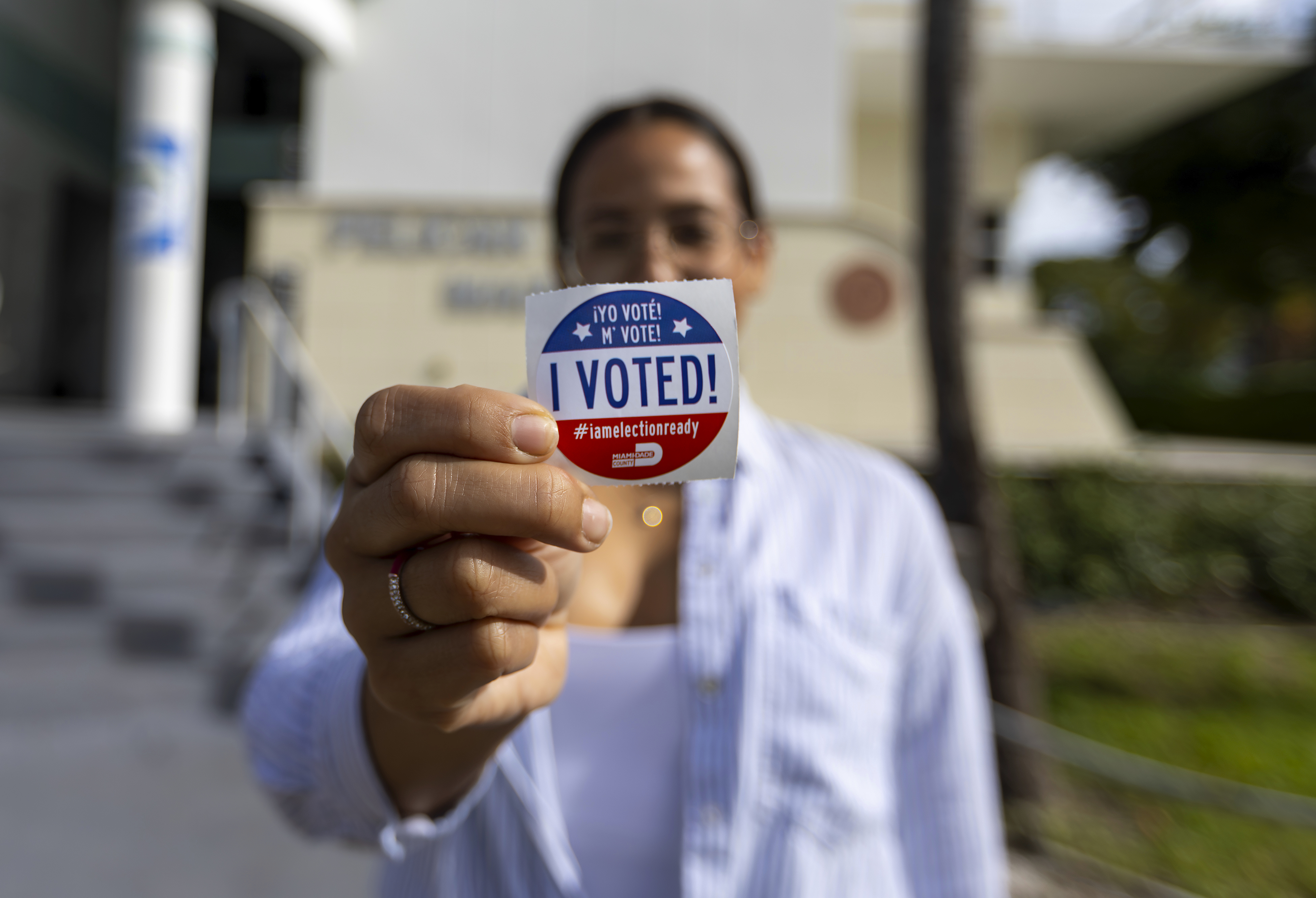
They are just dismantling the civil rights act piece by piece...
An act that would require people to register to vote using paper documentation of citizenship has been a focal point of town halls and petitions this week.

www.newsweek.com
Voters have been pressuring their representatives this week via town halls and petitions not to vote for the SAVE Act, a bill that may make it much harder for women, minorities, and working class people to register to vote.
The Safeguard American Voter Eligibility (SAVE) Act, introduced by Representative
Chip Roy, would amend the National Voter Registration Act to
require people to register to vote with paper proof of citizenship.
Citizens across the country have been asking their representatives to reject this proposal, as paper proof of citizenship not only creates a burdensome barrier to voting, but is additionally difficult for women whose married names do not match their birth certificate, people who have lost documents in natural disaster or moving house, older Black people who were denied hospital births and therefore do not have a birth certificate, and low income people who have not bought a passport.
Why It Matters
Voting is a fundamental right for all Americans over the age of 18, with the exception of felons in some states. Civil rights organizations have seen this bill as violating that right as it creates barriers to voting.
Citizenship is already required in order to vote, and people who lie about that face jail time or deportation.
House
Republicans have said
non-citizen voting is a serious concern, however, an audit conducted by Georgia Secretary of State
Brad Raffensperger in 2024 found only 20 noncitizens, out of Georgia's 8.4 million registered voters, were on the voter rolls. That is 0.00024 percent of the state's voter list. All 20 were referred to law enforcement and had zero effect on the election.
What To Know
The SAVE Act has become a focal point of town halls and petitions across the country.
In a letter dated February 24, Florida's Equal Ground coalition, alongside the Southern Poverty Law Center, the NAACP Florida State Conference, and other civil rights groups, asked their representatives to see the bill as "yet another obstacle in a long history of voter suppression tactics."
Their letter states that the SAVE Act is "a harmful piece of legislation that threatens to disenfranchise eligible voters in Florida and across the country."
Red Wine and Blue, a political organization which describes itself as a "community of women who use digital media and friend-to-friend organizing to change the world," shared footage of a
town hall earlier this week where a woman confronted Representative Rich McCormick about the SAVE Act, saying its paper proof of citizenship is "voter suppression."
The League of Women Voters of Westchester also
recorded and posted a town hall with Representative George Latimer on the SAVE Act, where the representative said: "[The bill authors'] acronym, SAVE, I think is a misnomer. The acronym that I think matters most...is stop all voter engagement. Because what we're doing here is stopping the engagement that has been created by having mail ballots, and mail registration that makes it easier for people to vote."
The SAVE Act lists several types of documentation that would be accepted in order to prove citizenship, including a form of identification issued consistent with the requirements of the REAL ID Act of 2005, a valid United States passport, valid military ID, forms of Tribal identification and proof of naturalization. Many of these forms of ID, other than a passport, either include a birth certificate or must be presented alongside a birth certificate.
The SAVE Act does not include proof of name change or a marriage certificate as acceptable proof of identity. This could be vital for married women with a birth certificate that does not match their current legal name, especially if they are one of the approximately 146 million Americans who do not have a passport.
Additionally, a recent study from the Center for Democracy and Civic Engagement found that 21.3 million people cannot readily access their citizenship documents.
Roy told
Newsweek in a previous article that creating a wider scope for proving identity, such as married women bringing both their birth certificate and their marriage license, to register to vote would be left up to the states.
However, one state, Arizona, which already tried to implement similar barriers to voting, has now had its laws struck down by the courts.
In 2022, Arizona created similar barriers to voting where voters have to provide documentary proof of citizenship and place of birth. The state also instituted frequent voter roll purges, something that is central to the SAVE Act. Both of these bills were overturned by the 9th U.S. Circuit Court of Appeals, citing civil rights violations.
Jonathan Diaz, director of voting advocacy and partnerships at Campaign Legal Center, told
Newsweek: "The top line is that the SAVE Act would create really significant new burdens on Americans to register to vote. It would make it harder for most eligible American citizens to register and cast a ballot. It would completely upend mail and online voter registration systems...especially in smaller and more rural counties. They don't have the money and the resources to do this without appropriations from
Congress, which the bill doesn't provide for."
Diaz explained that most government issued IDs do not include place of birth or citizenship, even many REAL IDs which are listed as an allowed piece of documentation in the SAVE Act. These parameters would not only hurt women, but would also heavily impact Native voters who may not have the U.S. listed as their place of birth on their tribal ID.
Cleta Mitchell from the Only Citizens Vote Coalition, who is a supporter of the SAVE Act, said: "When we change our names, we have to provide a birth certificate and marriage certificate to get our name changed at the Social Security office or on our bank accounts or credit cards or a zillion other places. It is a pain but millions of women do it every day."
However, detractors have argued that voting is a fundamental right, and politicians should be doing everything in their power to make it easier for citizens to engage with it, not erecting barriers which are "a pain."
Citizens who are already registered to vote will also likely be affected by the SAVE Act, as it calls for frequent voter roll purges. These purges often end up sweeping citizens off of the rolls, meaning people will then have to re-register with all of their paper documentation.
What People Are Saying
Jonathan Diaz, director of voting advocacy and partnerships at Campaign Legal Center, told Newsweek: "Among the groups that would be most affected by this are married women who have changed their names upon getting married, which a majority of married women in the United States do.
"Most of them do not have a birth certificate or other kind of citizenship document with their current legal name on it, and so you're even assuming that the states create filing process to satisfy the bill you would have to go to your elections office with your original birth certificate and your current ID, and mainly your marriage license and then some other form, but from when you changed your name, you know, with the Social Security Administration or whoever, and then all of a sudden you've got four or five difficult to obtain and expensive to reproduce government documents that you have to provide in person just to register to vote."
Representative Chip Roy told Newsweek: "This bill isn't being attacked because it'll exclude citizens from voting—it won't. It's being attacked because the policy is wildly popular with the American people, its opponents want and need illegals to vote, and they'll use anything they can to attack it."
What Happens Next
The 2025 SAVE Act has not been brought to a vote yet on the House floor. Its 2024 version was rejected by the
Senate which was under Democratic control at the time. However, this new vote on the act will likely pass both chambers.
If the bill passes it is likely to have little effect on noncitizens voting, as there are so few cases of noncitizens trying to vote, but it will make it significantly harder for Americans to be able to register to vote.