
Follow along with the video below to see how to install our site as a web app on your home screen.
Note: This feature may not be available in some browsers.

 www.foxbusiness.com
Additionally, Henley & Partners World’s Wealthiest Cities Report for 2025 found that both West Palm Beach and Miami surpassed New York City as the world’s fastest-growing wealth hubs. West Palm saw a 112% increase in millionaire growth over the last decade, while Miami saw a 94% increase.
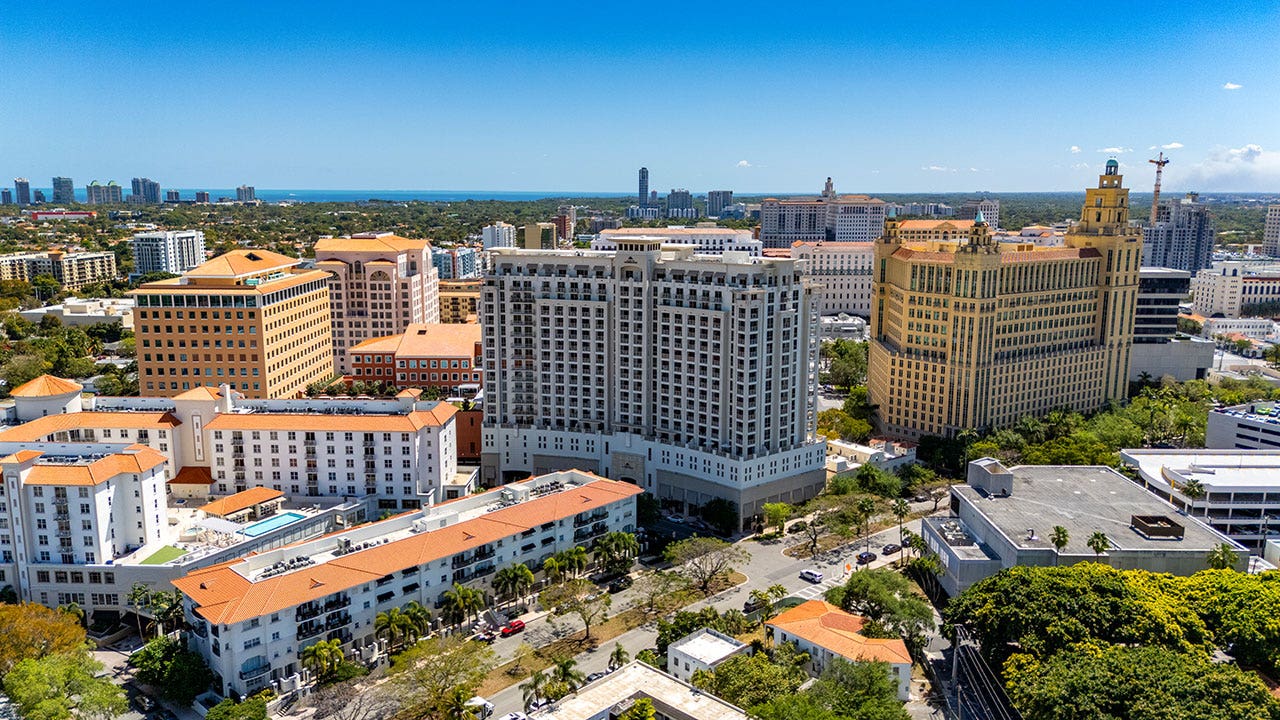
"We expect even more interest from ultra-luxury buyers looking to move to Coral Gables and the broader Miami area. As more buyers settle here, the neighborhood’s reputation as a world-class enclave will only continue to grow," Lugones noted.
Its residents enjoy high-level security with 24/7 armed guards on land and water. Entry into the community means paying a $100,000 non-refundable application fee to the larger Gables Estates Club. Zillow notes that home listing prices often exceed $21 million.
Most expensive neighborhoods in the U.S.:
1. Gables Estates, Coral Gables, FL
2. Port Royal, Naples, FL
3. Old Cutler Bay, Coral Gables, FL
4. Beverly Hills Gateway, Beverly Hills, CA
5. The Flats, Beverly Hills, CA
6. Shady Canyon, Irvine, CA
7. San Marino Island, Miami Beach, FL
8. Bear’s Club, Jupiter, FL
9. Palm Island, Miami Beach, FL
10. Rivo Alto Island, Miami Beach, FL
On Zillow's list, the least expensive neighborhood is Bullard Hill in Jackson, Mississippi, with an average home value of $24,026. Other neighborhoods include two in Shreveport, Louisiana; three in Flint, Michigan; and three in Jackson, Mississippi.
Lavish houses, often second or third residences, dot much of Miami’s waterfront. These are increasingly the homes of the ultra-wealthy — those with net worths exceeding $30 million. They’ve flocked in such great numbers that Miami is now the top global city for second homes of ultra-high net worth individuals, a new report found.
Some 13,200 such people, the most of any city on the planet, now keep a second home in the Miami metro area, according to Altrata, a wealth intelligence firm. In total, when you factor in primary residences, nearly 17,500 ultra-wealthy people have houses in Miami, the fourth-largest über-rich population in the world behind New York, Los Angeles and Hong Kong. And that trend, building for more than half a decade, doesn’t seem poised to stop anytime soon, said David Siddons, CEO of the David Siddons Group at Douglas Elliman, a luxury real estate firm in Coral Gables.
The stage was set for such a massive influx of wealth back in 2017, noted Ned Murray, associate director of FIU’s Metropolitan Center and an expert on South Florida’s housing market. That year’s Tax Cuts and Jobs Act, known as the Trump Tax Cuts, capped formerly limitless state and local tax deductions at $10,000. Previously, taxpayers could discount property, income and sales taxes paid to their local governments from their federal income taxes. That, said Murray, made living in high-tax states like New York or California less attractive relative to no-income tax states like Florida. But it was COVID, and the accompanying restrictions across much of the country, that drove the mega-wealthy to Florida.
To combat the city’s housing cost problem, the Metropolitan Center released its Affordable Housing Master Plan for the city of Miami back in 2020. Among its proposed solutions was an aggressive campaign of land banking — the purchase and holding of vacant properties to eventually repurpose them. The plan estimated that more than 90,000 new housing units could be built across the city of Miami’s vacant properties — enough to cover the estimated 90,000-unit affordable housing shortage for Miami-Dade households making less than $75,000 a year.
A vacancy tax on properties that sit empty for at least six months a year — as many ultra-wealthy vacation homes do — was also proposed as a means to fund affordable housing, as was a trust fund to finance such projects. “Of course, it never got adopted,” lamented Murray, one of the plan’s authors. “And now,” he added, “things are worse, because land prices are much higher.”
